
Duratec Roofing Solutions
Low-Slope Roofing: Systems and Solutions for Georgia Commercial Properties
- $Home
- $Low-Slope Roofing: Systems and Solutions for Georgia Commercial Properties
Choosing a low-slope roofing system comes down to more than just the material cost. Your building type, rooftop activity, maintenance needs, ownership plans, and existing roof condition all affect which option makes the most sense.
This guide compares the main commercial roofing systems used in Georgia, explains where each fits best, and shows what to look for when reviewing contractor bids. Use it to narrow your options before scheduling a professional roof assessment.
Key Takeaways
- TPO is the default choice for most Georgia commercial buildings because its reflective surface cuts heat gain through long, hot summers.
- PVC earns its higher price on restaurants and any roof exposed to grease or chemical exhaust.
- Modified bitumen and built-up roofing (BUR) hold up best where the roof sees heavy foot traffic and frequent equipment service.
- Roof coating is the cheapest way to extend a structurally sound roof, but only after moisture testing confirms the roof is dry.
Which Low-Slope Roofing System Fits Your Commercial Building in Georgia?
Choosing the right commercial roofing system comes down to three factors:
- how your building is used
- how much activity happens on the roof, and
- how long you plan to own the property.
Start by confirming what type of roof you have.
What Counts as a Low-Slope Roof
A low-slope roof is generally defined as one with a pitch of less than 3 inches of rise per 12 inches of run. Many people call it a flat roof, but the Georgia building code requires a minimum slope of one-quarter inch per foot for most membrane systems to prevent pooling water.
The key differences between low-slope and steep-slope systems come down to how long water stays on the surface. Steep-slope roofs drain water quickly, so overlapping asphalt shingles can effectively keep water out. Flat and low-slope roofs hold water longer, so the roofing membrane has to be completely watertight.
If your building also has sloped sections, such as a mansard or entry canopy, those areas fall under steep-slope commercial roofing and need their own specification.
The Short Answer by Building Type
The best roofing choice for a restaurant is rarely the best one for a warehouse. Most commercial roofing options fall into a clear pattern once you match them to how the building is used:
- Retail and multi-tenant properties: TPO, for its reflectivity and moderate cost
- Restaurants, commercial kitchens, and food processing: PVC, for its grease and chemical resistance
- Warehouse and distribution buildings: TPO, or standing-seam metal roofing if you plan a long hold
- Commercial and industrial buildings with heavy foot traffic or rooftop equipment: modified bitumen or BUR
- A sound roof with service life remaining: coating restoration
The table below compares typical lifespan, relative cost, and Georgia-specific factors for the main low-slope roofing systems.
| System | Typical Lifespan | Relative Cost | Best For | Georgia Consideration |
|---|---|---|---|---|
| TPO | 20 to 30 years | Moderate | Retail, office, warehouses | Reflective white surface cuts cooling load |
| PVC | 20 to 30 years | Moderate to premium | Restaurants, kitchens, food processing | Resists grease and chemical exhaust |
| EPDM | 20 to 30+ years | Lower to moderate | Budget-driven projects, simple roofs | Standard black surface absorbs heat; white options exist |
| Modified bitumen | 15 to 25 years | Moderate | Roofs with foot traffic and equipment | Reflective cap sheets available; torch limits on occupied buildings |
| Built-up roofing (BUR) | 20 to 30 years | Moderate to premium | Older buildings, high-traffic roofs | Heavy system, so confirm structural capacity |
| Standing-seam metal | 30 to 50+ years | Premium | Long-term holds, warehouses | Must be wind-rated, especially in coastal counties |
| Coating restoration | 10 to 20 years per application | Lowest | Sound roofs with life remaining | Humidity affects curing; silicone handles ponding best |
Lifespan ranges assume proper installation techniques and consistent maintenance. A well-installed mid-range system will outlast a poorly installed premium one.
Now, let’s take a closer look at each of these low-slope roof systems:
Single-Ply Membranes: TPO, PVC, and EPDM
A single-ply roofing is one waterproof sheet laid over insulation, and it makes up a large share of low-slope commercial roofing in the United States. The three main types differ in how their seams are joined, the color of their surface, and how well they handle chemicals.
Thermoplastic polyolefin (TPO)
TPO seams are joined with hot air, a process called heat welding. A properly welded seam is stronger than the sheet around it, which reduces risk at the most common leak point on a commercial roof.
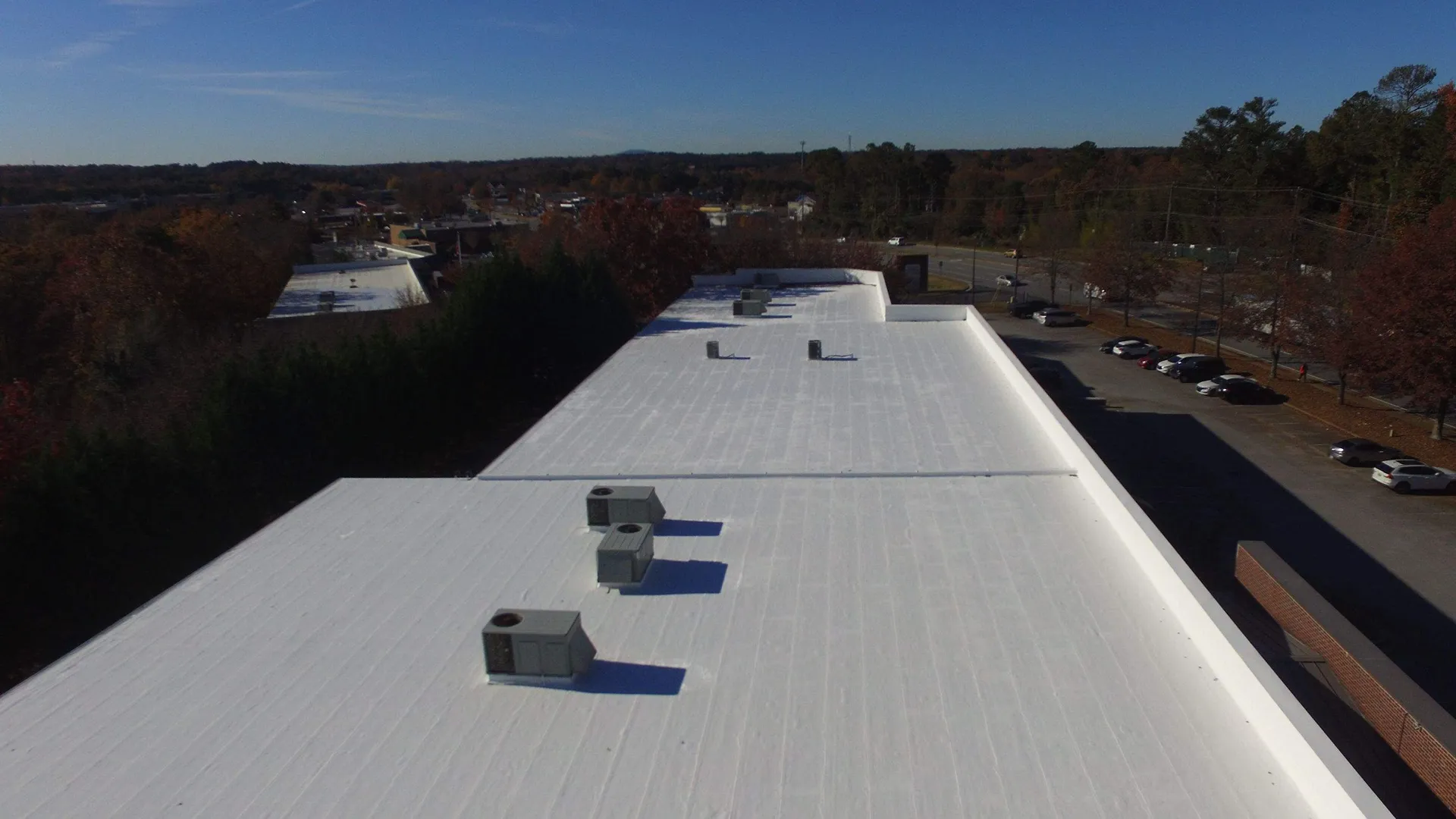
TPO’s white surface reflects most of the sun’s heat. A dark roof surface can run 50 degrees or more hotter than a white one on a summer afternoon in Georgia. So TPO’s reflectivity lowers cooling costs and supports energy efficiency goals.
- Common thickness: 60 mil (thousandths of an inch), with 80 mil for buildings you plan to hold long term
- Main strength: a strong balance of cost, reflectivity, and seam performance
- Main tradeoff: quality varies by manufacturer, and good seam welding requires a skilled crew
PVC
Polyvinyl chloride (PVC) is heat-welded like TPO and has the same reflective surface. Its advantage is resistance to chemicals, grease, and animal fats, which break down other membranes over time.
- Best for: restaurants, commercial kitchens, food processing, and facilities with chemical exhaust
- Main tradeoff: a higher price than TPO that buys little on an office or retail building without that exposure
EPDM
Ethylene propylene diene monomer (EPDM) is a synthetic rubber membrane with decades of field history. It resists punctures and hail well and is simple to patch, keeping maintenance bills at the lower end.
Its seams are joined with tape or adhesive, so seam condition becomes your main maintenance point. The standard black surface absorbs more heat, which can increase cooling demand during Georgia’s hot months. To prevent that, white EPDM is also available.
- Best for: budget-driven projects and simple roofs with few penetrations (pipes, vents, and equipment that pass through the roof)
- Main tradeoff: heat absorption and adhered seams that need regular checks
Multi-Ply Systems: Modified Bitumen and Built-Up Roofing
Multi-ply systems stack several layers, providing backup in case one of the layers is damaged. That redundancy delivers durability and weather resistance where the roof sees constant use.
Modified Bitumen
Modified bitumen is asphalt blended with rubber or plastic polymers so it stays flexible through heat and cold. It stands up well to foot traffic from technicians servicing HVAC units, and reflective cap sheets are available to reduce heat gain.
Common installation methods include:
- Torch-applied: heated with an open flame, which carries fire risk on occupied buildings
- Cold-applied: bonded with adhesive, a common choice when open flame is a concern
- Self-adhered: peel-and-stick sheets that avoid both flame and adhesive fumes
Built-Up Roofing
Built-up roofing (BUR) alternates layers of bitumen and reinforcing felt, usually finished with gravel or a mineral cap sheet. It is one of the oldest low slope roof systems still in use and remains common on older office buildings across Georgia.
BUR is heavy, so it’s important to ensure your building structure can carry the load before going forward. It also takes longer to install than single-ply, which means more disruption on an occupied building.
Metal Roofing and Roof Coatings
These two options sit at opposite ends of the cost range. Metal is a long-term investment, while roof coatings are among the most cost-effective solutions for extending a roof you already have.
Standing-Seam Metal on Low-Slope Roofs
Standing-seam metal uses panels joined by raised, interlocking seams that sit above the water flowing across the roof. Only certain structural profiles are rated for low slopes, so the minimum pitch depends on the manufacturer’s requirements for the panel you choose.
- Best for: long-term use, warehouses, and buildings where visual appeal matters on visible roof areas
- Main strength: the longest service life of any option here, with long-term protection and minimal upkeep
- Main tradeoff: the highest upfront cost and specialized installation
- Georgia-specific note: panels and attachments in coastal counties must be rated for higher design wind speeds
Coating Restoration
A roof coating is a liquid-applied layer, usually silicone or acrylic, that renews the surface of an existing roof. Depending on thickness, it can add roughly 10 to 20 years of service at a fraction of replacement cost, but only on a roof that is sound and dry underneath.
- Get an infrared moisture scan or core samples first, because coating over wet insulation traps moisture and speeds deterioration.
- Choose silicone where water collects, since it tolerates ponding better than acrylic.
- Plan the installation around Georgia humidity and dew, which affect curing and narrow application windows.
- Don’t expect improvement in drainage, since a coating keeps the roof’s existing slope.
Georgia-specific Conditions You Need to Consider
The same system can perform very differently in Georgia than in the Midwest, so judge roofing solutions against local conditions. Three factors most affect roof performance here: heat, storms, and drainage.
Heat, Humidity, and Energy Costs
Georgia’s long summers make roof reflectivity a direct operating cost. A reflective membrane reduces the heat your air conditioning has to remove, which matters most on large single-story commercial facilities.
A reroof can also trigger insulation requirements under the energy code Georgia adopts. Ask your commercial roof contractor about this at the start of your commercial roofing project, since it affects cost and system design. Also confirm it with your local building department.
Storms and Wind
Roof edges and perimeters fail first during high winds, so edge metal and membrane attachment must be rated for your building’s location. Coastal counties such as Chatham and Glynn carry higher design wind speeds than metro Atlanta, so a specification written for one market may not transfer to the other.
Humidity also slows drying between storms. That keeps moisture in damaged areas longer and speeds up hidden damage below the membrane.
Drainage Decides How Long Any System Lasts
Each inch of standing water adds about 5.2 pounds per square foot to your roof deck, and most roofing warranties exclude the damage it causes.
On a reroof, drainage solutions such as tapered insulation (boards cut to create slope) and crickets (small ridges that steer water around equipment) can fix problems without changing the structure.
Your building’s design determines which approach fits, so ask each bidder how they will move runoff to the nearest drain.
What to Ask Your Commercial Roof Contractor
A complete bid gives you what you need to make an informed decision. Inquire about the following from your contractor to compare different quotes on equal terms:
- The system, membrane thickness, and attachment method: mechanically fastened (screwed to the deck), fully adhered (glued), or ballasted (held down with stone)
- Insulation type, R-value (its resistance to heat flow), and any tapered design
- The edge metal detail and the drainage plan
- Warranty type, whether a manufacturer’s no-dollar-limit warranty (covering full repair cost) or workmanship-only coverage, plus the maintenance it requires of you
Warranty terms and maintenance requirements are where long-term maintenance costs hide. Knowing them before you sign keeps your roofing needs predictable for the life of the roof.
Start With the Building, Then Choose the System
The best commercial roof matches your building’s use, rooftop activity, and how long you plan to own it. Drainage and installation quality matter as much as the membrane you pick. Start with a moisture survey, then compare bids against the checklist above.
Let Duratec Roofing Solutions help you find the right roofing system for your property. Schedule your roof inspection today.
Call us now
706-819-2584