


Duratec Roofing Solutions
Commercial Roof Restoration vs Replacement Guide
- $Home
- $Commercial Roof Restoration vs Replacement Guide
When your commercial roof starts showing signs of wear, you face a critical decision: restore what you have or start from scratch. Understanding both options will help you make an informed decision that protects your budget while keeping your building watertight.
Key Takeaways
- Restoration is best for roofs that are 15-20 years old and have less than 25% damage to the existing roof system. At the same time, replacement is necessary when your roof is at the end of its lifespan or has widespread structural failure.
- Restoration typically runs $3-7 per square foot versus $8-18 per square foot for full replacement, making restoration 50-70% more cost-effective. For property owners evaluating long-term budgets, understanding commercial roof replacement costs in Georgia can help clarify when replacement makes more financial sense than continued restoration.
- Restoration adds 10-15 years to your existing roof, while a new roof provides 20-30 years of lifespan with proper maintenance.
- Tax treatment often differs: Both restoration and replacement may qualify for Section 179 benefits, though the specific classification depends on the scope of work.
- Code compliance triggers hidden costs during replacement, often requiring expensive insulation upgrades that restoration typically avoids.
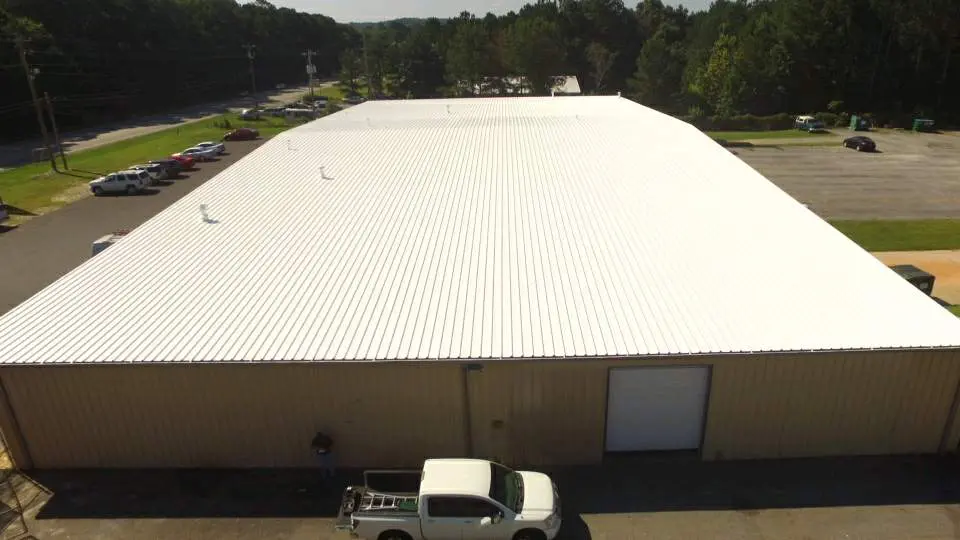
When to Consider Restoration vs. Replacement
The age and condition of your commercial roof determine which path makes financial sense. Here’s how to assess whether your existing roof system qualifies for restoration or needs complete replacement.
Roof Age Guidelines
TPO and EPDM roofs that are 15 years old or less are prime candidates for restoration if the substrate remains structurally sound. Metal roof systems can often be restored up to 20 years, while built-up roofs typically need replacement after 20-25 years.
If you’re specifically evaluating a metal system, this commercial metal roof restoration guide explains when restoration is practical and how it compares to replacement costs over time.
Age alone doesn’t determine your path; a 10-year-old roof with severe damage may need replacement, while a well-maintained 18-year-old roof might be perfectly restorable.
Extent of Damage
Minor damage (restoration candidates):
- Localized leak points at seams or penetrations
- Surface wear on the top membrane layer
- Weathering that hasn’t compromised the substrate
- Less than 25% of insulation is wet or saturated (industry guideline)
Major damage (replacement required):
- Widespread leaks across multiple roof sections
- Soft spots indicating failed decking
- Structural deflection is visible when walking on the roof
- More than 25% of insulation saturated (industry guideline)
Roof Restoration: What It Is & When It Works
What Is Roof Restoration?
Roof restoration transforms your existing roof without tearing anything off. The process includes three critical steps: pressure washing to remove dirt and debris, repairing all damage points with fabric reinforcement and mastic, and applying a specialized roof coating system that seals your entire roof system.
When It Makes Sense
Restoration works when three conditions align:
- Your roof is under 15-20 years old (metal roof systems can stretch to 25 years)
- The substrate and decking are structurally sound with no soft spots
- Damage affects less than 25% of your roof area (based on industry best practices)
Benefits
Cost savings dominate the restoration advantage:
- 50-70% less than full replacement at $3-7 per square foot
- Eliminates tear-off costs, no removal labor or disposal fees
- Avoids the expense of buying new insulation
- Adds 10-15 years to your existing roof’s lifespan
Energy efficiency provides measurable returns:
- High-quality reflective roof coating systems can reflect up to 85% of UV rays when newly applied
- Reduced cooling loads can lower cooling costs by 10-25% depending on climate and building type
- Many utility companies offer rebates for Energy Star-rated cool roofs
- Energy savings can significantly reduce your total cost of ownership
The renewable factor extends roof life:
- Can be recoated multiple times over several decades with proper maintenance
- At year 15 or 20, pressure wash and apply a new top coat to extend life another 10-15 years
- Each recoat cycle can renew warranty coverage, depending on the manufacturer’s terms. For a clearer understanding of how different commercial roofing warranties work – and what they actually cover-refer to our guide to understanding commercial roof warranties.
- Significantly delays the eventual need for full replacement
Timeline and disruption stay minimal:
- Most projects are complete in 5-8 days versus 2-3 weeks for replacement
- Low noise levels, the pressure washer is the loudest equipment
- Minimal business interruption in most cases
- Your roof stays closed and protected throughout
Tax benefits may accelerate ROI:
- May qualify for immediate tax deduction depending on the scope of work and IRS classification
- Potential for Section 179 expensing (up to $1,160,000 as of 2023) if work qualifies as an eligible property improvement
- Alternatively, it may be classified as deductible maintenance rather than capital improvement, requiring 39-year depreciation.
(Note: Tax treatment depends on the specific nature and scope of work. Tax codes are complex and change annually. Always consult your tax professional before making financial decisions.)
Limitations
Restoration won’t fix structural issues in your decking or substrate. If you have soft spots or deflection, you need a full roof replacement. Severely aged roofs beyond 20-25 years typically lack the structural integrity to support a coating system. Warranty coverage depends on the coating thickness meeting the manufacturer’s specifications.
Roof Replacement: What It Is & When It’s Required
What Is Roof Replacement?
A full roof replacement means the complete removal of your existing roof down to the deck. Crews tear off all membranes, insulation, and roofing material, inspect and repair the structural deck, then install a completely new roof system. The process typically requires 1-3 weeks for an average commercial building of 10,000-50,000 square feet.
When It’s Necessary
Replacement becomes mandatory when your commercial roof crosses specific thresholds:
- Any roof over 20-25 years old (typically reached the end of its lifespan)
- More than 25% of insulation is wet or saturated (industry guideline for replacement)
- Failed substrate with soft spots or structural deflection
- Widespread ponding that threatens steel deck integrity
- Rusted fasteners throughout the system
Benefits
Long-term performance and warranty:
- Modern TPO and PVC membranes provide 20-30 years of lifespan with proper maintenance
- Manufacturers back installations with 10-20 year warranties
- Addresses all underlying issues from the foundation up
- Peace of mind knowing your commercial roof is completely rebuilt
Limitations
Cost hits hard:
- $8-18 per square foot, 2-4 times the price of restoration
- For 20,000 square feet: $160,000-$360,000 versus $60,000-$140,000 for restoration
Disruption affects operations:
- Heavy noise from drilling, banging, and cranes for 2-3 weeks
- Dumpsters and staging areas block access
- Roof stays open during work, high risk if rain hits mid-project
- Requires consistent dry weather for full timeline
| Metric | Replacement (20,000 Sq. Ft.) | Restoration (20,000 Sq. Ft.) |
|---|---|---|
| Upfront Cost | $160,000–$360,000 | $60,000–$140,000 |
| Lifespan | 20–30 years (then tear off) | 10–15 years (renewable with recoating) |
| Calendar Time | 14–21 days | 7–10 days |
| Noise Level | High (drilling, cranes) | Low (pressure washer) |
| Building Risk | Open roof during work | Closed roof throughout |
| Warranty | 10–20 years (often pro-rated) | 10–20 years (terms vary by manufacturer) |
| Disruption | Heavy staging, dumpsters | Light equipment only |
*Requires recoating every 5-8 years
Key Decision Factors
Roof Condition Assessment
You need a professional roof inspection to make this decision; a ground-level visual assessment won’t cut it. A licensed commercial roofer will identify replacement indicators:
- Structural deflection in the decking
- Soft spots when walking on the roof
- Widespread ponding of water
- Rusted fasteners throughout the system
Important note on ponding: Standing water can damage asphalt roofs and acrylic coatings, but silicone restoration coatings are specifically designed to handle it. Ponding alone doesn’t mandate replacement unless the weight threatens the structural integrity of your steel deck.
Budget Realities
If your inspection shows you’re a candidate for both options, calculate the 15-year cost:
- Restoration: $3-7 per square foot (can be recoated at years 15-20)
- Replacement: $8-18 per square foot (will eventually need replacement again at year 20-30)
- Calculate total cost over time, not just upfront expense
Insurance complicates the math: Insurance companies pay for damage from hail or wind, not aging. If a storm damages your commercial roof, they’ll cover the cost of a new roof. They rarely pay to coat an existing roof, even if restoration would be the more cost-effective choice.
The Hidden Cost: Code Compliance and Insulation
Here’s what most property owners don’t discover until they get replacement quotes: tearing off typically triggers current building energy codes (IECC) in most situations.
The rule: When you tear off a roof and the existing roof assembly is part of the building’s thermal envelope with insulation entirely above the roof deck, you typically must comply with current energy codes.
The consequence: Most older commercial properties have 1-2 inches of insulation. Current code often requires R-20 to R-30, or higher, depending on your climate zone (roughly 4-6 inches of common insulation).
The cost: Your replacement quote includes thousands of dollars in new insulation boards, plus labor to raise curbs, pipes, and HVAC units. A 20,000-square-foot roof might need an additional $40,000-$60,000 in insulation alone.
Restoration typically avoids this: Because restoration is generally classified as maintenance rather than new construction, you’re usually grandfathered in without required insulation upgrades. Important exceptions may apply depending on local jurisdiction; verify with your local building department.
Timeline and Operational Impact
If you can’t afford weeks of disruption:
| Metric | Replacement | Restoration |
|---|---|---|
| Actual Labor Days | 12–15 days | 5–7 days |
| Staging Area | Heavy (dumpsters, pallets) | Light (drums/buckets) |
| Business Impact | Significant interruption | Minimal disruption |
Making Your Decision
Questions to Answer
Is your insulation wet or dry?
- Industry best practice: Under 25% wet → restoration is viable
- Industry best practice: Over 25% wet → replacement typically required
- Saturation level is often more critical than age for determining the appropriate solution
What are your tax planning priorities?
- Both restoration and replacement may qualify for Section 179 expensing (up to $1,160,000 as of 2023)
- Smaller repair/maintenance work may be immediately deductible as a business expense.
- Large-scale improvements (including both restoration and replacement) may require capitalization and depreciation.
- Specific tax treatment depends on the scope, nature, and cost of your roofing project.
(Consult your tax professional for guidance specific to your situation; they can help determine the optimal tax strategy.)
Are energy costs a pain point?
- Restoration: High-quality cool roof systems can reflect up to 85% of UV rays, potentially reducing cooling costs by 10-25%
- Replacement: Standard grey or black membranes don’t offer this benefit unless you upgrade to white TPO
- In high-cooling-cost climates, energy savings can represent substantial long-term value.
Is your goal long-term roof life or a one-time fix?
- Restoration: Can be recoated multiple times over decades, significantly delaying the need for eventual replacement
- Some manufacturers offer non-prorated warranties that maintain full material coverage throughout the warranty period.
- Replacement: New 20-30 year lifespan starts immediately
- Many replacement warranties are pro-rated, meaning coverage value decreases annually
Can your site handle heavy logistics?
- Replacement: Cranes, dumpsters, heavy noise for 2-3 weeks
- Restoration: Low-profile, quiet, minimal business disruption
- If your commercial building operates 24/7 or hosts sensitive operations, restoration creates fewer operational challenges
What does your professional inspection show?
- Get quotes from three licensed commercial roofers
- Compare both options side-by-side
- Verify insurance and review warranty terms carefully
Frequently Asked Questions
My building already has two layers of roofing. Do I have to tear it off?
No. Restoration is typically classified as “maintenance” rather than a third roof layer, allowing you to avoid tear-off costs. Building codes usually permit coating over two existing layers, though you should verify with your local building department.
Will maintenance crews damage the coating when servicing HVAC units?
Coatings are durable but not invincible. For roofs with heavy foot traffic from HVAC service or window washing, install walk pads or reinforced fabric pathways to protect the coating from boots and dropped tools.
Are there utility rebates available for cool roof restoration?
Yes, in many markets. White coatings reflect up to 85% of UV rays, reducing peak demand on power grids. Many utility companies offer per-square-foot rebates for Energy Star-rated cool roofs. Check with your local energy provider.
What happens when the warranty expires?
Restoration systems can be renewed. Pressure wash the roof and apply a new top coat to extend life another 10-15 years and potentially renew warranty coverage. This cycle can repeat multiple times before substrate failure requires full replacement.
Does coating just cover up existing leaks?
No. Technicians must first identify and repair all existing leaks, wet insulation, and open seams using fabric reinforcement and mastic. The coating then goes over a 100% watertight surface to seal and protect it from future degradation.
Conclusion
Your choice depends on the roof’s age, the extent of damage, and your budget and timeline. Roofs under 15 years old with limited damage are strong candidates for restoration, especially given tax benefits and energy savings. Roofs beyond 20-25 years or those with widespread structural damage require complete replacement for durability and peace of mind.
Call us now
706-819-2584