

Duratec Roofing Solutions
TPO Roofing: Comprehensive Guide for Georgia Commercial Buildings
- $Home
- $TPO Roofing: Comprehensive Guide for Georgia Commercial Buildings
Why are so many commercial property owners in Georgia switching to TPO roofing? Is it actually worth it for your building?
In this guide, you’ll learn:
- What is TPO
- Why TPO performs so well in Georgia’s climate
- What it really costs to install TPO
- how long does TPO last
- Warning signs of a TPO roof
Read the article and make a confident decision before your next roofing project forces your hand.
What Is TPO Roofing & How Does It Work?
TPO, short for thermoplastic polyolefin, is a single-sheet roofing membrane made from polypropylene and ethylene-propylene rubber.
Instead of relying on multiple layers like older built-up systems, it protects the roof with one continuous layer. The sheet includes a polyester reinforcing mesh sandwiched between its surfaces, which helps it resist tearing while staying flexible.
White TPO is the most common because it reflects sunlight and heat, but it’s also available in gray, tan, and black.
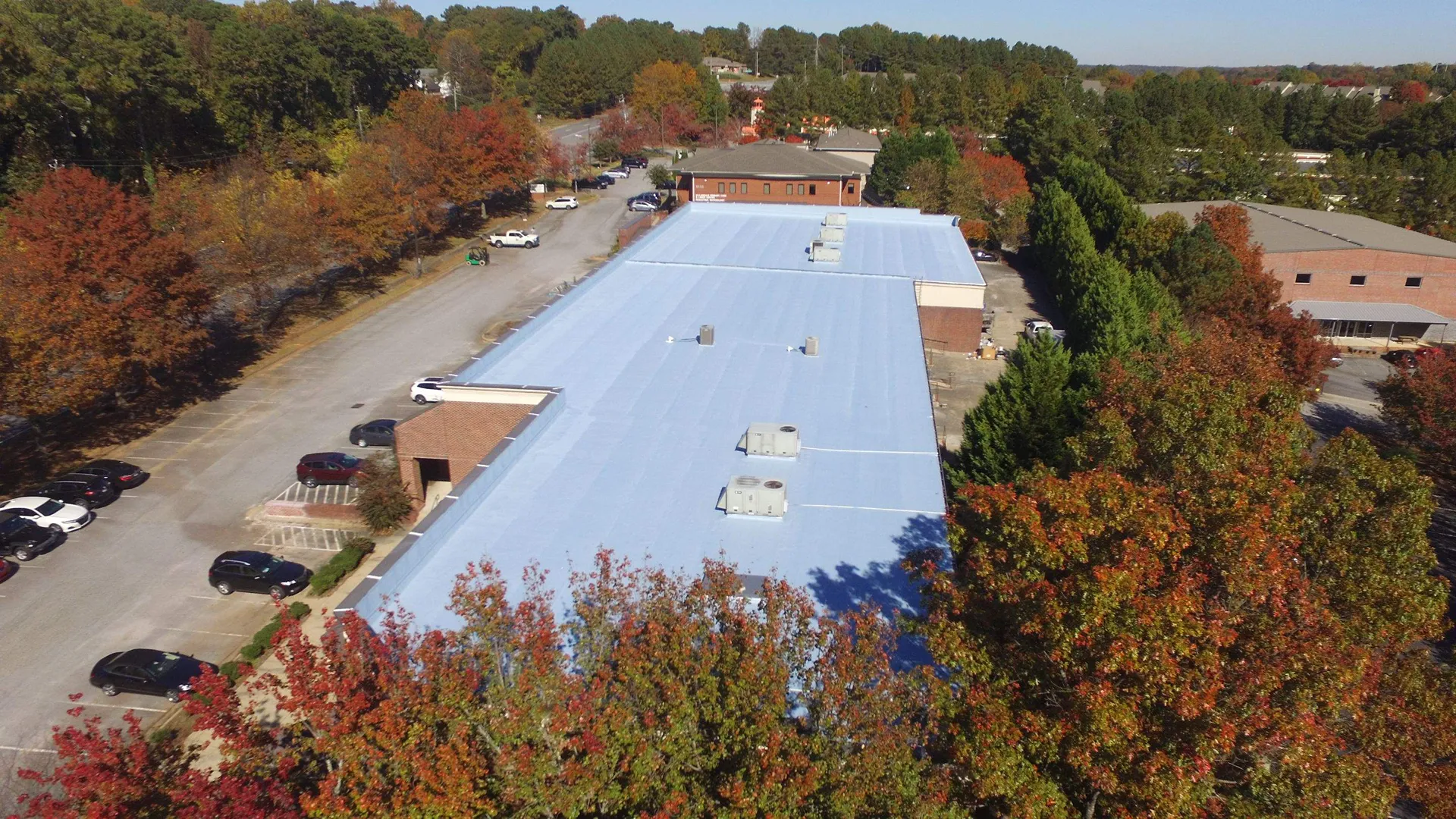
Why TPO Roofing Works Well in Georgia’s Climate
Georgia’s heat, humidity, and frequent storms are tough on roofs, but TPO is designed to reflect sunlight, resist moisture-related growth, and stay watertight through daily temperature swings and heavy rain.
Heat Reflection & Energy Efficiency
In Atlanta summers, temperatures often hit the 90s and humidity regularly climbs above 60–70%, so a dark roof soaks up sunlight and heats up like a radiator. That extra heat pushes into the building and makes the HVAC system run harder and longer.
A white TPO roof helps by reflecting about 70–80% of the sun’s UV rays, which can lower the roof surface temperature by roughly 50–60°F compared to a dark roof.
Want to push those savings further? Adding a reflective roof coating on compatible roof areas can enhance reflectivity and help keep rooftop temps down during Georgia’s longest heat stretches.
For many commercial buildings in Georgia, this change can cut cooling costs by about 20–30%. It often works out to roughly $3,000–$5,000 in yearly savings for a typical 20,000-square-foot facility.
Humidity Resistance
Georgia’s humid, subtropical weather makes roofs a prime target for mold and algae. But TPO’s synthetic material naturally helps resist that kind of growth. It also stands up well to Georgia’s strong sunlight because it resists UV rays and ozone, two things that can speed up roof aging.
Weather Resistance
As temperatures swing from hot 90°F days to cooler 60°F nights, TPO can expand and contract without cracking or putting stress on the roof. And, when afternoon thunderstorms roll in, its heat-welded seams fuse together to form a watertight seal that helps keep rain out.
Installation Costs in Georgia
Understanding actual costs requires breaking down key components and variables driving pricing. You can expect total roofing installation costs between $5 and $10 per square foot for commercial TPO roofing in Georgia.
Material and Labor Breakdown
The TPO membrane material costs $1.50-$3.50 per square foot, depending on thickness. Insulation boards add $0.50-3.00 per square foot, with polyiso around $2.00.
Labor is typically $2.50 to $6.00 per square foot because TPO seams have to be heat-welded, and that takes skill.
| Cost Component | Price Range per Sq Ft |
|---|---|
| TPO Membrane (45-80 mil) | $1.50 - $3.50 |
| Labor & Installation | $2.50 - $6.00 |
| Insulation (Polyiso) | $0.50 - $3.00 |
| Total Installed Cost | $5.00 - $10.00 |
Installation Method
The way a TPO roof is installed makes a big difference in the price.
The least expensive option is a “weighted” system, where the membrane is held in place by gravel or pavers. It usually costs around $1.50–$2.50 per sq. ft. Weighted systems work best on large, low-wind roofs that can handle the added weight.
A step up is a “fastened” system, where the roof is screwed down with special plates. It typically costs within $2.00–$3.00 per sq. ft. Fastened systems are a solid all-around choice for most commercial buildings.
The priciest option is a “glued” system, where the membrane is fully adhered to the roof surface for strong wind performance. It usually costs around $2.75–$3.50 per sq. ft. Glued systems are the best fit for high-wind areas or roofs with tricky shapes where you want the strongest hold.
Project Size
It’s interesting to note that larger projects usually cost less per square foot than smaller ones because crews can work more efficiently on larger projects. On a typical 20,000 sq. ft. commercial flat roof, a full TPO installation often lands around $100,000–$200,000.
Costs can increase if:
- The old roof has to be torn off ($1–$2 per sq. ft.)
- There are lots of rooftop pipes and units to work around (about $200–$500 each)
- The edge metal and waterproof “trim” work is extensive ($50–$500 per linear foot)
- The project is in busy urban areas (15–25% higher)
For the most accurate number, it’s best to get a detailed quote from a certified contractor. In fact, you can get a free roof evaluation from Duratec Roofing Solutions.
Expected Lifespan and Long-Term Performance
A well-installed TPO roof made with good materials can last 15 to 30 years, with most systems landing in the 20 to 25 year range. How long it really holds up depends a lot on the quality of the membrane.
Top manufacturers like GAF, Carlisle SynTec Systems, Firestone Building Products, Versico Roofing Systems, and Conklin Company tend to perform better because they put more into testing, formulas, and quality control.
In Georgia, that quality matters even more because direct sun rays and daily temperature swings can wear roofing materials faster than they would in milder climates.
Common Failure Points
Understanding where TPO roofs fail helps property managers prevent problems and recognize warnings:
- Seam separation due to improper welding technique is the most common TPO failure mode
- UV degradation, particularly in older installations that lacked modern UV stabilizers
- Membrane shrinkage resulting from low-quality materials or insufficient attachment methods
- Punctures from foot traffic, dropped tools, or equipment installations and repairs
Treat any leak as an immediate inspection item. If the membrane is cracking, brittle, or splitting in multiple areas, it’s likely reaching the end of its service life. When the surface is stained and no longer reflective, especially for systems that are 15+ years old, replacement planning is usually the most cost-effective next step.
Maintenance Requirements
To get the full lifespan out of a TPO roof, you need a simple, consistent maintenance routine.
For roofs under 10 years old, plan on one inspection each year. Once the roof hits 10 years, switch to inspections in the spring and fall. After any major storm, check the roof right away so small damage doesn’t turn into leaks.
During each inspection, pay closest attention to the areas where problems usually start (seams, flashing at edges and walls, and drains) and spots where pipes or equipment pass through the membrane.
Routine Tasks Your Team Can Handle
Property maintenance teams can manage basic roof maintenance tasks that can extend the life of your TPO roof:
- Remove debris quarterly to prevent drain clogs and trapped moisture
- Clear drains and check for ponding water after heavy rains (water sitting 24-48+ hours indicates drainage issues)
- Inspect and reseal flashings annually around penetrations where sealants break down faster than TPO
- Clean membrane with low-pressure washing and manufacturer-approved cleaners (avoid harsh chemicals)
- Check for blistering or soft spots during roof walks (indicates trapped moisture or adhesion problems)
Making the Decision: Is TPO Right for Your Georgia Building?
Best Fit Buildings
TPO is a strong choice for flat or low-slope commercial roofs (about a 2:12 pitch or less), especially on buildings where keeping cooling costs down matters.
It’s commonly used on warehouses, retail centers, office buildings, and industrial facilities because the reflective surface can improve energy efficiency without adding a lot of weight or complexity.
It’s also a practical option for properties with rooftop HVAC units, since the membrane holds up well to service foot traffic and is relatively easy to repair and maintain around equipment.
When TPO May Not Be Ideal
Buildings with heavy rooftop traffic should consider 80 mil membranes or PVC alternatives. Facilities exposed to grease or harsh chemicals, commercial kitchens, or manufacturing plants, should evaluate PVC for superior chemical resistance despite higher costs.
If you’re comparing membrane options, this detailed breakdown of TPO vs PVC roofing explains how the two systems differ in durability, chemical resistance, and long-term cost.
Key Selection Criteria
When choosing a TPO roof for a commercial building, start with the basics:
- Pick a membrane that’s at least 60 mil thick which is the minimum commonly recommended for commercial use by the National Roofing Contractors Association.
- Buy from a reputable manufacturer and make sure the warranty matches your expectations. Many systems offer 15 to 30 years.
- Confirm the contractor is properly trained and certified by the brand they install (for example Conklin Company, GAF, Carlisle SynTec Systems, or Firestone Building Products), because workmanship has a huge impact on performance.
- Choose an installation method that meets local code and wind requirements for your site.
- Weigh the upfront cost against long-term savings, especially if a reflective roof can reduce your cooling bills.
| TPO Thickness | Expected Lifespan | Best For | Typical Cost Premium |
|---|---|---|---|
| 45 mil | 15-20 years | Low-traffic roofs, budget projects | Baseline |
| 60 mil | 20-25 years | Standard commercial applications | +15-20% |
| 80 mil | 25-30 years | High-traffic roofs, extreme durability | +30-40% |
Frequently Asked Questions
Does TPO roofing work with solar panel installations?
Yes, TPO provides an excellent base for solar arrays. The reflective surface keeps panels cooler for better efficiency, and the membrane’s durability handles mounting hardware without issues when properly flashed.
Can you walk on TPO roofing without damaging it?
Yes, TPO handles foot traffic well, especially 60-80 mil thicknesses. However, install designated walkway pads from roof access points to HVAC equipment to prevent wear patterns and extend membrane life.
How does TPO perform during Georgia hail storms?
TPO resists moderate hail impact well, with thicker membranes (60-80 mil) providing better protection. Severe hail can puncture any roofing material. One should inspect immediately after major storms and document damage for insurance claims.
Is TPO roofing environmentally friendly?
Yes, TPO is 100% recyclable and contains no chlorine. Energy Star certification, reflective properties reducing urban heat island effect, and long lifespan minimizing landfill waste make TPO an eco-conscious choice.
Getting Started: What to Do Before You Request TPO Roofing Quotes
At this point, you should have enough clarity to decide whether TPO belongs on your shortlist and to talk about it confidently with contractors.
The next step is to walk your roof (or have your team do it) and note the basics: roof size, drainage/ponding areas, how much rooftop equipment you have, and any signs of wear around seams and penetrations.
Then gather two or three written quotes that spell out the membrane thickness, insulation type, installation method, warranty terms, and who is responsible for flashing and details.
Ask each contractor to explain why they’re recommending that system for your location and wind exposure, and make sure the proposal includes an inspection and maintenance plan going forward.
With those details in hand, you can compare bids apples-to-apples, budget realistically, and choose a roof that fits your building.
Call us now
706-819-2584