
Duratec Roofing Solutions
Commercial Roof Energy Savings: How the Right System Reduces Costs
- $Home
- $Commercial Roof Energy Savings: How the Right System Reduces Costs
In Georgia, your roof can have a noticeable effect on how much you spend to cool your building. Dark roofing materials absorb intense summer heat, while more energy-efficient systems are designed to limit that heat gain.
This guide explains how roofing materials, reflectivity, insulation, and installation choices can influence energy use and help reduce long-term operating costs.
Key Takeaways
- Your roof can be a major source of heat gain in a commercial building, especially when it has a large footprint, dark surface, or inadequate insulation.
- Reflective roofing systems can reduce surface temperature by 50°F or more compared to a conventional dark roof, according to the U.S. Department of Energy.
- Georgia commercial electricity rates are currently around 11 to 12 cents per kWh, although individual utility rates and demand charges vary.
- Proper roof insulation (R-25 minimum above deck for most of Georgia under the state energy code) works alongside reflective roofing materials to prevent heat gain year-round.
- Membrane type, insulation value, and installation quality all affect long-term savings and total cost of ownership.
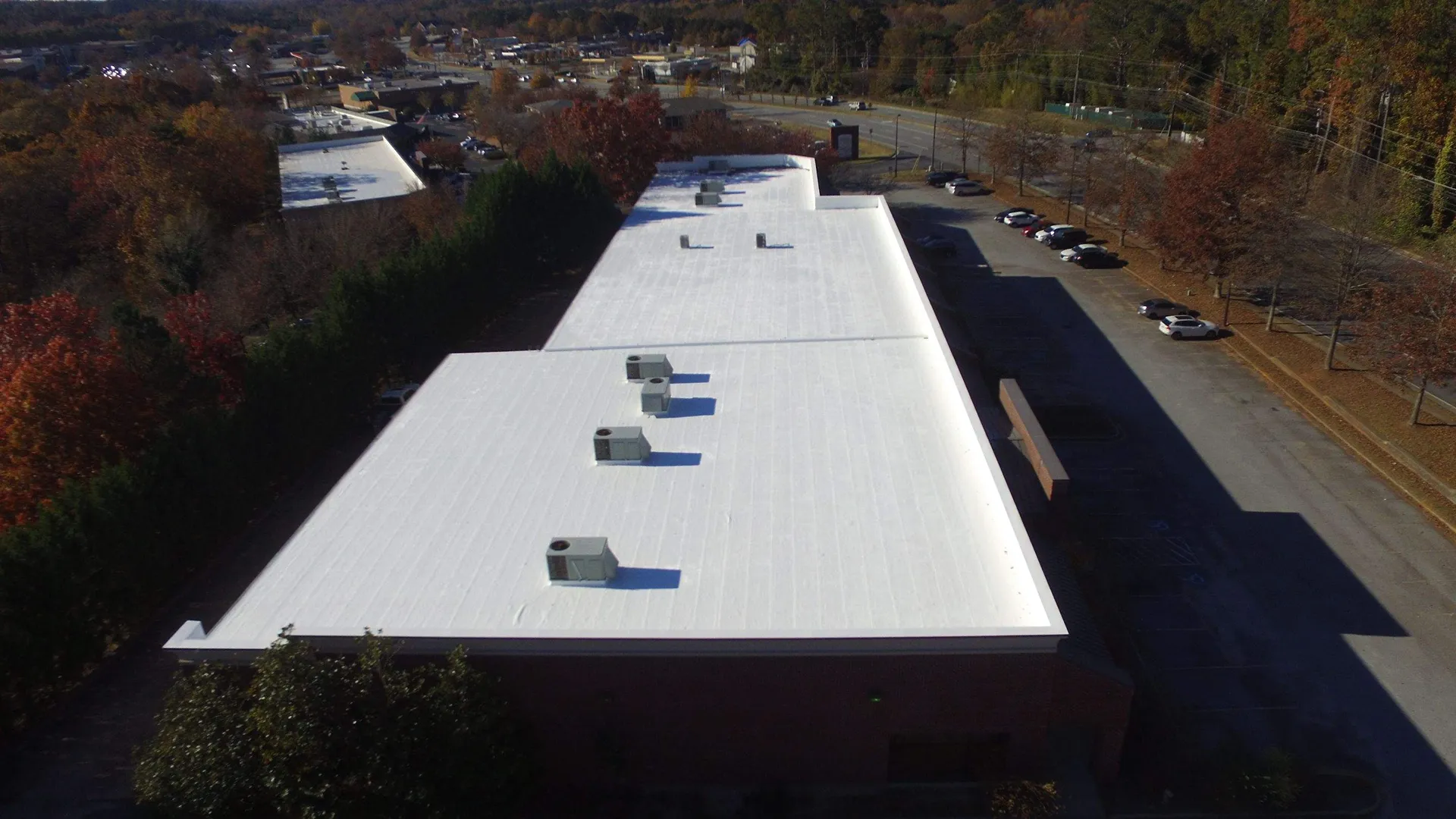
Why Your Commercial Roof Has a Direct Impact on Energy Costs
How Heat Transfer Works Through a Commercial Roof
Commercial roofs absorb some of the solar energy that reaches them, with darker surfaces generally absorbing much more than reflective ones. That energy is converted to heat, conducted through the roof assembly, and radiated into the building interior, increasing energy consumption.
Dark commercial roofs can become extremely hot under direct summer sun, while cool roofs may remain as much as about 60°F cooler under comparable conditions. Your air conditioning system compensates for that constant thermal load, driving up electricity usage and equipment wear.
What Makes Georgia’s Climate Especially Demanding
Most of Georgia falls in IECC Climate Zone 3. Heating and cooling typically represent 30 to 40% of a commercial building’s total energy bill in this region.
Your cooling season runs from April through October, giving you seven months of intense solar exposure. High humidity compounds the problem because your HVAC works harder to manage both temperature and moisture.
Roofing Systems That Reduce Commercial Energy Costs
Three categories of energy-efficient roofing systems deliver measurable energy savings for commercial properties in Georgia.
Reflective Single-Ply Membranes (TPO and PVC)
Many white TPO and PVC membranes have high solar reflectance, allowing them to reflect a large share of incoming solar energy instead of converting it into roof-surface heat.
Heat-welded seams provide single-ply membranes waterproofing in Georgia’s high-rainfall environment (over 50 inches annually). With proper maintenance, a TPO or PVC membrane typically lasts 20 to 30 years and delivers significant energy savings from the first cooling season.
Metal Roofing with Reflective Coatings
A high-quality metal roof with a solar-reflective coating (typically a PVDF paint system) combines strong solar reflectance with exceptional longevity. Standing seam metal roofing can exceed a 50-year lifespan, potentially offsetting the higher upfront cost compared to two TPO installations over the same period.
Metal roofs have wind ratings exceeding 140 mph practical advantage during Georgia’s severe storm season. Metal also helps reduce energy consumption across your facility and contributes to reducing the urban heat island effect in dense commercial areas. For overall energy efficiency and durability, metal is a strong long-term choice.
Roof Coatings as a Retrofit Solution
If your existing roof is structurally sound, cool roof coatings can improve its energy performance without a full replacement. Reflective silicone or acrylic coatings can be applied to existing roofs to boost solar reflectance and reduce cooling energy costs.
Both silicone and acrylic coatings can provide high initial reflectivity, but dirt accumulation affects long-term performance. Conventional silicone can attract dirt, so aged reflectance and product-specific ratings matter more than initial whiteness alone.
A quality coating can extend your current roof’s service life by 10 to 15 years. However, if your membrane has widespread leaks or moisture damage, a coating will not solve structural issues. Neither is reliably visible from a walk-through, because water usually enters the roof well away from the point where it appears inside, which is why tracing a commercial roof leak to its source takes more than a surface check. It’s best to get a professional commercial roof inspection before taking the next step.
Comparing Energy-Efficient Commercial Roofing Systems
At Duratec Roofing, we work with commercial building owners across Georgia to match the right room system to each property’s goals. The table below compares performance factors across the three main commercial roof systems.
| Factor | TPO / PVC Membrane | Metal (Reflective Coating) | Reflective Roof Coating (Retrofit) |
|---|---|---|---|
| Solar Reflectance | Up to 80–90% | 60–75% (with PVDF coating) | 70–85% (white silicone) |
| Typical Lifespan | 20–30 years | 40–50+ years | 10–15 years (coating life) |
| Estimated Cooling Cost Reduction | 10–30% | 7–15% | 7–15% |
| Best For | Low-slope flat roofs | Steep-slope or mixed-use | Existing roofs in fair condition |
| Relative Upfront Cost | Moderate | Higher | Lower |
Actual savings depend on building size, insulation, HVAC condition, and utility rates. Data from the Lawrence Berkeley National Laboratory and Cool Roof Rating Council.
The Role of Insulation in Commercial Roof Energy Performance
Georgia’s Minimum Insulation Requirements
For commercial roofs using insulation entirely above the deck, prescriptive R-values commonly increase from R-25 in the warmer Georgia climate zones to R-30 in Climate Zone 4.
These requirements are especially relevant to new construction and substantial reroofing projects, although the insulation required on an existing building depends on the project scope and applicable code provisions.
Why You Need Insulation and Reflectivity Work Together
A reflective roof and proper thermal insulation serve complementary functions. The reflective membrane reduces heat by reflecting solar energy, while insulation prevents conducted heat from reaching the interior.
A cool roof with inadequate insulation will underperform because conducted heat bypasses the reflective benefit. If you are already investing in a new roof, upgrading insulation while the deck is exposed is the most cost-effective approach. This also reduces thermal cycling (expansion and contraction), which extends membrane life.
How to Estimate Your Potential Energy Savings
Factors That Affect Your Actual Savings
Your actual energy cost reduction depends on several building-specific factors:
- Roof area: Larger surfaces gain more from a reflective system.
- Current roof type: A darker surface will see a greater improvement than one that is already somewhat reflective.
- HVAC system age: Older systems consume more energy per unit of cooling, amplifying the benefit.
- Existing insulation: Buildings with minimal insulation gain the most from a combined upgrade.
- Local utility rate: At $0.10-$0.12/kWh, every percentage point of energy use reduction translates into real savings.
For Example
Consider a 50,000 sq. ft. commercial building in metro Atlanta that spends $45,000 per year on electricity, with cooling accounting for 35 to 40% of the bill. That puts annual cooling costs around $16,000 to $18,000.
If an energy-efficient roof reduces those costs by 15 to 20%, you save roughly $2,400 to $3,600 per year. Over a 20-year roof lifespan, that adds up to $48,000 to $72,000 in cumulative cost savings. Actual results depend on building-specific conditions.
What to Look for When Choosing an Energy-Efficient Commercial Roof
Key Performance Metrics
Solar Reflectance and SRI
The Solar Reflectance Index (SRI) measures how well a roofing surface reflects solar heat and releases absorbed heat. It combines solar reflectance and thermal emittance into a single rating, where a higher number generally means a cooler roof surface.
For low-slope commercial roofs, an initial SRI of 78 or higher is commonly used as a benchmark for high-reflectance roofing. This threshold was also used in earlier ENERGY STAR roof-product criteria.
Insulation R-Value
Confirm that your roofing contractor plans to meet or exceed Georgia’s R-25 minimum for Zone 3 (or R-30 for Zone 4). Higher R-values may qualify for a utility rebate and can support green building certifications depending on your project scope.
Questions to Ask Your Commercial Roof Contractor
When evaluating contractors for your next roofing project, these questions help assess their understanding of energy performance:
- What is the SRI rating of the membrane you are recommending?
- Will the insulation meet or exceed the Georgia energy code minimums?
- How do heat-welded seams compare to adhesive seams for waterproofing?
- What is the estimated cost of ownership over 20 years, including energy and money saved?
Frequently Asked Questions
How much can a reflective roof save on cooling costs for a commercial building in Georgia?
Most commercial property owners in Georgia can expect a 10 to 20% reduction in cooling costs with a reflective roofing system. Savings depend on building size, insulation levels, and HVAC efficiency. Over a 20-year roof lifespan, those savings add up to tens of thousands of dollars.
Does Georgia have energy code requirements for commercial roof insulation?
Yes. Georgia follows the amended 2015 IECC. Climate Zone 3 (most of the state) requires R-25 continuous insulation above the roof deck. Zone 4 (northern Georgia) requires R-30. These apply to new construction and roof replacements.
Is a roof coating enough to improve energy efficiency, or do I need a full replacement?
It depends on your current roof’s condition. If the existing membrane is structurally sound, a reflective coating can improve energy performance and extend the roof’s life by 10 to 15 years. If the roof is failing, a full replacement with upgraded insulation is the better long-term investment.
What is the difference between solar reflectance and SRI?
Solar reflectance measures how much sunlight a surface reflects on a scale from 0 to 1. SRI combines reflectance and thermal emittance into a single 0-100 score. For low-slope commercial roofs, an SRI of 78 or higher is a strong benchmark.
How long does it take to see a return on investment from an energy-efficient commercial roof?
Most building owners see measurable reductions in utility bills within the first full cooling season. The full ROI timeline depends on system cost, building size, and local energy rates.
A reflective coating or incremental cool-roof upgrade may recover its additional cost relatively quickly, while a full roof replacement usually needs to be evaluated on total lifecycle cost rather than energy savings alone.
Find Out What an Energy-Efficient Roof Could Save
The right commercial roof system pays back through lower energy expenses, less strain on your HVAC, and a longer-lasting roof. Evaluate your current roof’s energy performance and take the next step toward reducing your operational costs.
Ready to find out what an energy-efficient roof could save your building? Contact Duratec Roofing for a free assessment of your commercial property.
Call us now
706-819-2584