
Duratec Roofing Solutions
Spray Foam Roofing: Is It Right for Your Georgia Commercial Building?
- $Home
- $Spray Foam Roofing: Is It Right for Your Georgia Commercial Building?
If your commercial roof is aging, leaking, or driving up energy costs, spray foam roofing may be worth considering. Known for its seamless application, insulating value, and ability to restore many existing roof systems, spray polyurethane foam roofing has become an increasingly popular option for commercial building owners across Georgia.
But like any roofing solution, it is not the right fit for every property.
This guide offers a practical overview of spray foam roofing for commercial buildings in Georgia. We’ll explain how spray polyurethane foam roofing works, what it typically costs, where it performs best, where it may fall short, and what building owners should know before making a decision.
Key Takeaways
- Spray foam roofing (SPF) is one of the highest-performing commercial roof materials for energy efficiency.
- SPF delivers an R-value of approximately 6.5 per inch, which can significantly reduce cooling costs in Georgia’s hot, humid climate.
- Installation requires dry conditions above 50°F, so timing your project matters given Georgia’s weather patterns.
- An SPF roof can last 30 years or more with proper maintenance, and it can be recoated rather than fully replaced, reducing long-term costs.
What Is Spray Foam Roofing?
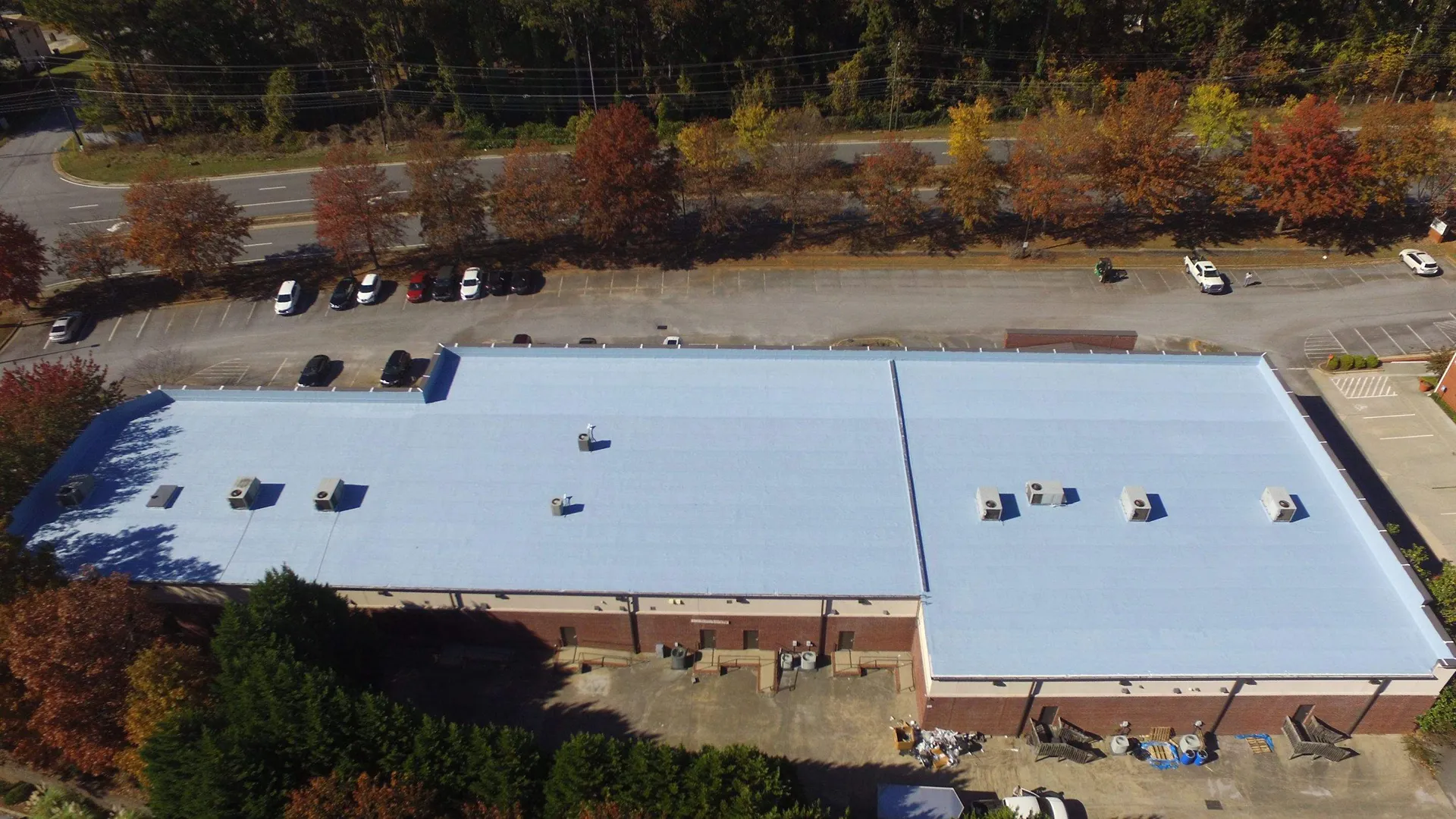
Spray foam roofing is a seamless commercial roof system made by applying liquid polyurethane foam that expands, hardens, and creates an insulated, waterproof barrier. It has been used in commercial roofing applications since the 1960s.
How SPF Roofing Works
Spray polyurethane foam (SPF) is a two-component liquid foam system. The two chemicals, isocyanate and polyol, are heated, mixed at the point of application, and sprayed directly onto the roof surface.
The liquid foam that expands and hardens into a solid foam layer bonds directly to your existing roof, creating a single, continuous insulation material with no joints or gaps.
Once the foam cures, a protective elastomeric coating, typically silicone, is applied to the roof surface to shield it from UV exposure and physical wear. This coating is what gives the roof its weather resistance and reflectivity.
What Types of Commercial Roofs Can Get SPF?
One of the biggest practical advantages of SPF is that it can be applied over most existing roofing materials.
Regardless of the type of your existing roof, spray foam can be applied to it directly; without requiring a full tear-off. This matters for your bottom line. Skipping the tear-off saves on labor, disposal fees, and business disruption.
However, there is one important condition:
Your existing roof must be structurally sound, fully adhered, and free of excessive moisture. If more than roughly 25% of your roof insulation is saturated, a tear-off becomes necessary regardless of which new roof system is installed.
Why Georgia Commercial Building Owners Should Consider SPF Roofing
Energy Efficiency in Georgia’s Heat
If rising energy costs are a major concern, SPF can help improve your building’s efficiency and reduce cooling demand. The closed-cell spray foam insulation delivers the highest R-value per inch of any commercial roof insulation, approximately 6.5 per inch.
R-value measures thermal resistance, your roof’s ability to resist heat transfer. The higher the number per inch, the less heat escapes through your building’s roof in winter and the less heat penetrates in summer.
In Georgia’s climate zone (zone 3), cooling demand dominates your energy costs for six to eight months of the year. A spray foam roofing system helps reduce that load by adding continuous insulation with no thermal bridging or seams where conditioned air can escape. The silicone topcoat adds further protection by reflecting UV light, helping keep interior temperatures lower without overworking your HVAC system.
Some building owners report up to 30% savings in HVAC-related energy costs after SPF installation. While every roof is different and results vary by building type, the combination of high R-value insulation and a reflective coating makes SPF one of the most energy-efficient roofing options for Georgia’s climate.
Seamless Waterproofing for Heavy Rainfall
Georgia averages roughly 50 inches of rain annually, and seams and penetrations are the number one source of commercial roof leaks. Every joint and flashing point on a traditional roof is a potential failure point where water can get in.
SPF eliminates this vulnerability:
Since the foam is sprayed as a continuous layer, the finished roof has no joints, seams, or laps. It creates a seamless barrier that wraps around penetrations such as HVAC units, pipes, and vents during the application process.
The foam can also be shaped during application to improve drainage. Your commercial roof contractor can build slopes and crickets (small ridges that direct water flow) to reduce ponding water on flat roofs, a chronic problem on low-slope commercial buildings in Georgia.
Lightweight and Structural Flexibility
At approximately 0.25 pounds per square foot, SPF adds very little weight to your building’s structure. This makes it a practical option for commercial buildings in Atlanta and across North Georgia, especially older properties where load capacity may be limited and heavier systems, such as built-up roofing or ballasted single-ply membranes, may not be ideal.
Beyond the weight advantage, the foam also adds rigidity to your roof deck once cured. This added rigidity improves wind uplift resistance, which prevents high winds from compromising your roof during Georgia’s severe thunderstorm season.
Potential Drawbacks and Limitations
Weather-Dependent Installation
SPF can only be installed when temperatures are above 50°F, the roof surface is completely dry, and humidity is relatively low. In Georgia, this means foam roof installation is best scheduled in late spring, summer, or early fall.
Morning dew must be completely removed from the roof surface before spraying begins, and work typically stops before evening dew forms. This narrows the productive work window on many days.
If your roofing projects need to happen during Georgia’s wettest months (March and July tend to have the heaviest rainfall), SPF may not be the most practical roofing material for your timeline.
Vulnerability to UV Exposure
The foam itself has zero UV resistance. It relies entirely on the protective topcoat to survive sun exposure. If the foam coating wears thin and is not recoated, the foam will degrade, leading to cracking and moisture infiltration.
This is the most common cause of SPF roof failures, and it is entirely preventable. Building owners who have negative experiences with spray foam almost always defer maintenance rather than encounter a product failure.
So what should you do? Schedule regular inspections to monitor the health of your roof’s topcoat, and recoat it before the foam becomes exposed.
Overspray Risk During Application
Because spray foam is applied using high-pressure equipment, wind can carry fine foam particles onto nearby vehicles, equipment, or adjacent buildings. Experienced roof contractors mitigate overspray risk by:
- Monitoring wind speed and direction before and during application
- Using containment measures such as tarps and barriers
- Scheduling spray work during low-wind periods
- Communicating with neighboring property owners in advance
While it is not a product defect, it is worth asking your roof contractor about their overspray prevention protocols.
Finding a Qualified Contractor
SPF installation requires specialized equipment, trained technicians, and a deep understanding of the foam’s chemistry. It is not a type of roof that any general roofing contractor can install competently. Improperly mixed or applied foam can lead to poor adhesion, blistering, and trapped moisture, all of which are costly to fix.
When choosing the right roof contractor, look for these qualifications:
- Certification through the Spray Polyurethane Foam Alliance (SPFA), which offers an ISO-17024-compliant professional certification program
- A portfolio of completed commercial SPF roofing projects in Georgia
- Willingness to provide references from building owners with similar building types
- Clear documentation of their quality control process during foam application
How Much Does Spray Foam Roofing Cost?
Upfront Cost
Commercial SPF roofing typically costs between $5 and 12 per square foot installed. The wide range reflects several variables:
- Roof Size: Larger roofs (20,000+ square feet) tend toward the lower end due to economies of scale
- Foam thickness: Thicker applications increase material costs but deliver higher R-values
- Condition of the existing roof: If tear-off or substrate repair is needed, add $1 to 3 per square foot
- Type of topcoat: Silicone coatings cost more than acrylic but last longer in Georgia’s UV-intense environment
Long-Term Cost Comparison
Upfront cost alone does not tell the full story. When comparing foam vs traditional roofing systems, the total cost of ownership over 20 to 30 years matters a lot. That includes maintenance, recoating, energy savings, and eventual replacement.
| Factor | SPF Roofing | TPO/EPDM Single-Ply | Built-Up Roofing (BUR) |
|---|---|---|---|
| Installed Cost (per sq ft) | $5 to 12 | $5 to 10 | $8 to 18 |
| R-Value per Inch | ~6.5 | 0.24 to 0.33 (membrane only) | ~3.5 (with insulation) |
| Lifespan | 30+ years (with recoating) | 15 to 25 years | 20 to 40 years |
| Tear-Off Required? | Often not | Usually yes | Usually yes |
| Recoating Option | Yes ($1.50 to 3.00/sq ft) | No, full replacement | No, full replacement |
| Maintenance Frequency | Semi-annual inspections | Annual inspections | Annual inspections |
The key differentiator is SPF’s renewability. Unlike TPO or a built-up roofing system, an SPF roof does not need to be torn off and replaced when it reaches the end of its service life. Since the foam underneath does not lose its R-value over time, recoating at 10- to 20-year intervals extends the roof’s lifespan indefinitely.
Over a 30-year period, a single TPO roof will likely need full replacement at least once, while an SPF roof may only need two or three recoatings at $1.50 to $3.00 per square foot each. That difference can amount to tens of thousands of dollars in savings on a mid-size commercial building.
For a closer look at the long-term financial benefits, learn how commercial roof coatings can save money by extending roof life and delaying a full replacement.
Note: Actual costs vary, so getting multiple quotes from reputable commercial roof contractors is the best way to estimate your specific situation.
SPF Roof Maintenance: What to Expect
Routine Inspections
SPF roofs should be inspected twice a year, typically in spring and fall, and after any severe weather event such as hail, high winds, or heavy storms.
Inspections should focus on the following three things:
- Topcoat condition (looking for thinning, cracking, or discoloration)
- Foam surface integrity (checking for punctures, gouges, or animal damage)
- Drainage (ensuring water is not ponding in low spots)
Most SPF roofing contractors offer maintenance contracts that include spray foam roof inspections and minor repairs. These contracts are worth considering because catching small issues early prevents expensive problems later.
For a broader year-round upkeep plan, use our commercial roof maintenance checklist to stay ahead of drainage issues, coating wear, punctures, and other problems before they become costly repairs.
Recoating Schedule
The silicone coating on top of the spray foam typically needs to be recoated every 10 to 20 years, depending on the original thickness applied and your building’s UV exposure. Recoating costs approximately $1.50 to $ 3.00 per square foot and includes a new warranty period.
The recoating cycle is why an SPF roof can last 50 years or longer. The closed-cell foam underneath does not degrade as long as it remains protected by an intact coating. You are essentially renewing the roof’s outer shell while keeping the effective insulation layer fully intact.
Foot Traffic Precautions
SPF roofs can support foot traffic for routine maintenance, but the surface is more vulnerable to puncture damage than rigid foam board or metal roofing systems.
Here’s how you can protect your SPF roof:
- Use soft-soled shoes
- Install designated walkway pads around HVAC units and roof-mounted equipment
- Train maintenance personnel to avoid dragging tools across the surface
Is SPF Roofing the Right Fit for Your Building?
The right commercial roofing solution depends on the needs of your commercial building, your budget, and the operational needs of your business.
Use the framework below to make an informed decision.
SPF May Be a Strong Fit If…
- Your building has a flat or low-slope commercial roof
- You want to avoid the cost and disruption of a full roof tear-off, and your existing roof is in reasonable condition
- Energy costs are a significant factor, especially given Georgia’s long cooling season, where lowering energy bills matters
- Your existing roof is structurally sound, but aging or showing early signs of leaks at seams and penetrations
- You are willing to commit to semi-annual inspections and timely recoating
SPF May Not Be the Best Choice If…
- Your existing roof has more than 25% moisture saturation in the insulation, making a tear-off necessary
- Your building is in tight proximity to neighboring properties, where overspray during foam application is a high-risk concern
- You need the roof replaced during Georgia’s rainy season or winter months, when installation conditions are unreliable
- Your building requires a roofing system that handles heavy, regular foot traffic without walkway modifications
- You cannot commit to the semi-annual inspection and recoating schedule that SPF requires
If you are still uncertain, the best next step is a professional roof assessment. A qualified roofing contractor can pull core samples from your existing roof to test for moisture saturation, evaluate your building’s structural condition, and give you a practical recommendation on whether SPF is the right fit for your commercial property.
Frequently Asked Questions
How long does it take to install a spray foam roof on a commercial building?
Most SPF installations are completed in one to four days for a standard commercial roof, though larger or more complex roofing projects can take longer. The timeline is typically faster than traditional roof replacement because no tear-off is required and the foam is sprayed directly onto the existing roof surface in a continuous application.
Can spray foam roofing be installed over my existing roof?
In most cases, yes. SPF can be sprayed on the existing roof surface, including metal, concrete, TPO, EPDM, and built-up roofing, as long as the existing system is fully adhered and free of excessive moisture.
Does spray foam roofing meet Georgia building codes for commercial properties?
SPF roofing systems can meet or exceed Georgia building codes for insulation and R-value when applied at the appropriate foam thickness. Your contractor should confirm compliance with local codes and obtain the necessary permits before roof installation begins.
What happens if my spray foam roof gets damaged?
Small punctures and surface damage can be repaired easily by cleaning the affected area and applying new foam and coating. More extensive damage may require professional repair by your roofing contractor. Regular inspections help catch issues early before they affect the overall health of your roof.
Is spray foam roofing environmentally friendly?
SPF roofing generates minimal waste during foam installation and throughout its lifetime because it is recoated rather than torn off and replaced. Unlike other roof insulations that require complete removal at the end of life, SPF stays in place and is renewed. It also helps reduce energy bills through superior insulation performance, lowering your building’s carbon footprint over time.
The Next Step
Start with a professional roof assessment. A qualified commercial roof contractor can pull core samples to test for moisture saturation, evaluate your building’s structural condition, and give you a clear recommendation on whether SPF is the right fit. That single inspection will tell you more about your specific situation than any article can.
If you are ready to find out whether spray foam roofing makes sense for your commercial building, our team at Duratec Roofing can help you evaluate your options.
Call us now
706-819-2584